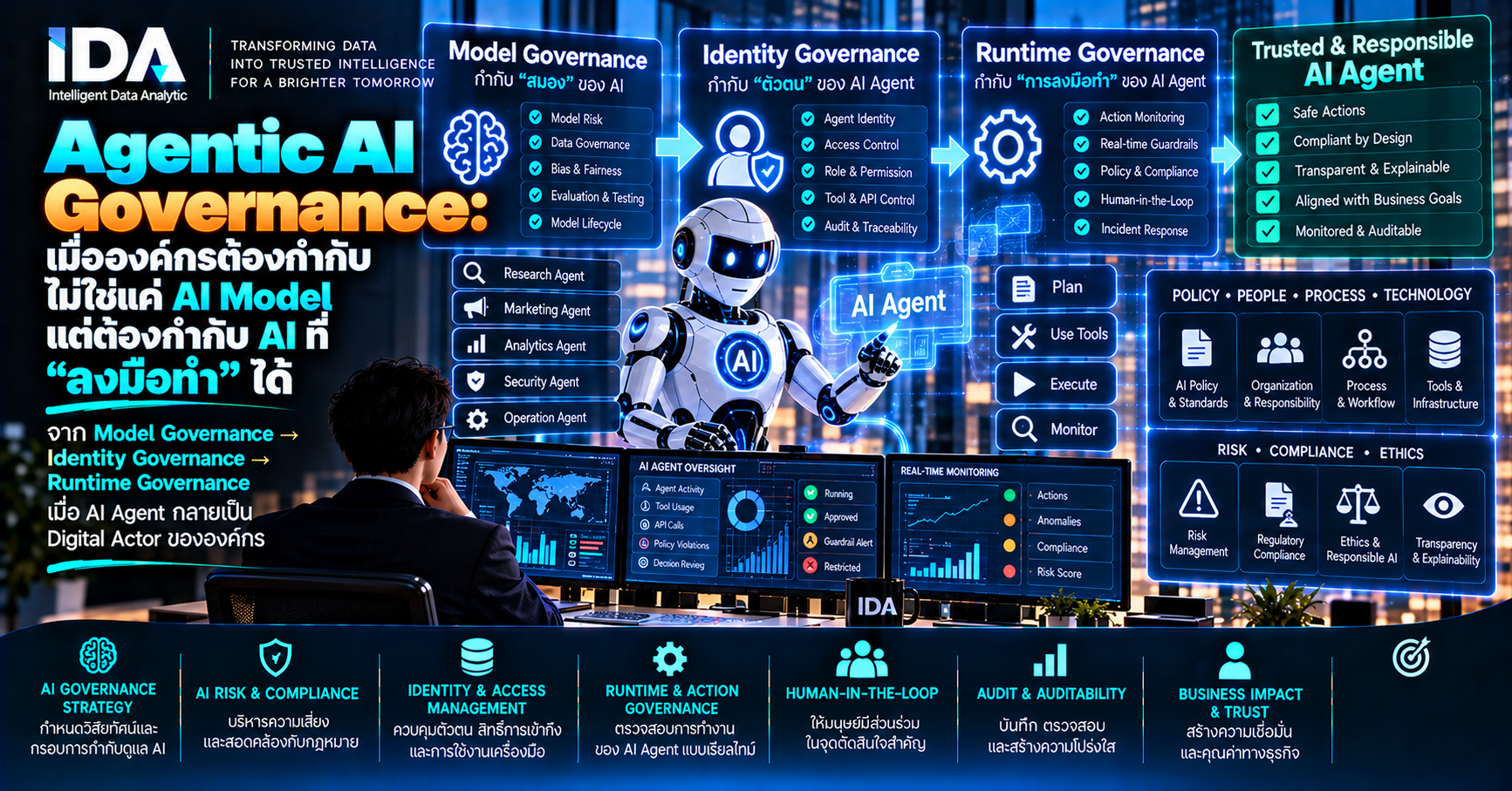
Agentic AI Governance: เมื่อองค์กรต้องกำกับไม่ใช่แค่ AI Model แต่ต้องกำกับ AI ที่ “ลงมือทำ” ได้
จาก Model Governance → Identity Governance → Runtime Governance เมื่อ AI Agent กลายเป็น Digital Actor ขององค์กร
การเปลี่ยนแปลงครั้งสำคัญของ Enterprise AI ในปี 2026 ไม่ใช่เพียง AI ฉลาดขึ้น แต่คือ AI เริ่มมีสิทธิ์ลงมือทำ AI รุ่นแรกทำหน้าที่ Answer → Generate → Summarize → Recommend แต่ Agentic AI สามารถ Observe → Reason → Plan → Access Data → Use Tools → Execute → Monitor → Adapt ความแตกต่างนี้ทำให้โจทย์ของ AI Governance เปลี่ยนไปอย่างสิ้นเชิง เพราะความเสี่ยงไม่ได้อยู่เพียงว่า
“AI ตอบผิดหรือไม่?”
แต่กลายเป็น
“ถ้า AI ตัดสินใจผิด มันสามารถทำอะไรต่อได้บ้าง?”
จาก AI Risk สู่ Agentic AI Risk
Generative AI แบบเดิมสร้างความเสี่ยง เช่น Hallucination Bias Privacy Copyright Data Leakage และ Misinformation แต่ Agentic AI เพิ่ม Risk Dimensions ใหม่ Identity Access Permission Tools Autonomy Execution Delegation และ Machine-to-Machine Interaction
ดังนั้น Risk Model เปลี่ยนจาก Bad Answer ไปสู่ Bad Action
ตัวเลขที่ผู้บริหารควรให้ความสนใจ
งานวิจัยของ SailPoint ที่เผยแพร่ในปี 2025 พบว่า 82% ขององค์กรที่สำรวจใช้งาน AI Agents แล้ว ขณะที่ 98% มีแผนเพิ่มการใช้งาน แต่มีเพียง 44% ที่รายงานว่ามีนโยบายด้าน Security สำหรับ AI Agents และ 80% รายงานว่าเคยพบ Agent ทำ Unintended Actions เช่น
เข้าถึง System ที่ไม่ได้รับอนุญาต เข้าถึงข้อมูลที่ไม่เหมาะสม แชร์ Sensitive Data หรือ Download Sensitive Content ที่น่ากังวลกว่านั้นคือ 23% รายงานว่า AI Agent เคยถูกหลอกให้เปิดเผย Access Credentials ตัวเลขเหล่านี้ไม่ได้หมายความว่า AI Agents 80% “Rogue” แต่สะท้อนสิ่งที่สำคัญกว่า Enterprise Adoption กำลังเดินเร็วกว่าระบบ Governance
Adoption ↑ แต่ Governance ตามไม่ทัน
นี่คือ Structural Risk องค์กรกำลังเดินจาก AI Experiment → AI Assistant → AI Workflow → AI Agent อย่างรวดเร็ว แต่ Security Architecture ของหลายองค์กรยังออกแบบสำหรับ Human User + Application + Service Account ไม่ได้ออกแบบสำหรับ Autonomous Digital Actor
ที่สามารถตัดสินใจและเลือก Action เองได้ ดังนั้นปัญหาไม่ได้อยู่เพียง AI Capability แต่คือช่องว่างระหว่าง AI Capability กับ Governance Maturity
AI Agent คือ Identity ประเภทใหม่
องค์กรเคยบริหาร Identity หลัก ๆ เช่น Employee Administrator Application Machine Service Account API แต่ Agentic AI เพิ่ม Identity ใหม่ Agent Identity
AI Agent อาจมี Username API Key OAuth Token Cloud Credential Database Access Email Access CRM Access และ Tool Permissions
ดังนั้น Agent ไม่ควรถูกมองเป็นเพียง Feature ของ Software แต่ควรถูกมองเป็น Non-Human Digital Identity ที่ต้องได้รับ Governance
Human Permission ≠ Agent Permission
นี่คือหลักการสำคัญที่สุดข้อหนึ่ง สมมติ CFO สามารถเข้าถึง Financial Data Banking ERP Budget และ Investment Information ไม่ได้หมายความว่า AI Agent ของ CFO ควรได้รับ Permission ทั้งหมดของ CFO เช่นเดียวกัน ถ้า CMO สามารถ ใช้ Budget Upload Customer Audience
Publish Campaign และ Export CRM Data ไม่ได้หมายความว่า Marketing Agent ควรมีสิทธิ์ทั้งหมดนั้น ดังนั้น Human Identity → Delegated Agent Identity → Scoped Permission ต้องเป็น Architecture พื้นฐาน
Agentic Least Privilege
หลัก Least Privilege ต้องขยายจากมนุษย์ไปสู่ AI Agent ควรได้รับ เฉพาะ Data + Tool + Permission ที่จำเป็นสำหรับ Task ตัวอย่าง Agent ที่ทำ Executive Report ต้องการ Read Access แต่ไม่จำเป็นต้องมี Write / Delete Access Agent ที่วิเคราะห์ Customer Data อาจไม่จำเป็นต้องเห็น Raw Personal Identifiers Agent ที่ Monitor Cybersecurity ไม่ควรสามารถ Disable Firewall ได้เองโดยอัตโนมัติ หลักคือ Give the Agent the Minimum Authority Required to Complete the Task.
ปัญหาใหญ่: Traditional IAM อาจยังไม่เพียงพอ
Identity & Access Management แบบเดิมมักถามว่า Who are you? What can you access? แต่ Agentic AI ต้องถามเพิ่ม Why are you accessing it? For which Goal? Using which Tool? Under whose authority? For how long? และ What action will follow? ดังนั้น Permission ในยุค Agentic AI ต้องมี Context มากขึ้น
Static Permission → Dynamic Permission
รูปแบบเดิม User → Role → Permission อาจต้องพัฒนาเป็น Human → Agent → Goal → Context → Data → Tool → Permission → Action และ Permission อาจเป็น Task-bound Time-bound Data-bound Tool-bound และ Risk-bound นี่คือ Context-Aware Agent Authorization
จาก Zero Trust สู่ Zero Trust for AI Agents
หลัก Zero Trust คือ Never Trust, Always Verify เมื่อนำมาใช้กับ Agentic AI ต้องเพิ่ม Never Assume Intent เพราะแม้ Agent จะ Authenticate ถูกต้อง ก็ไม่ได้หมายความว่า ทุก Action ที่ Agent เลือกจะถูกต้อง ดังนั้น Authenticated Agent ≠ Trusted Action Architecture ต้องตรวจทั้ง Identity + Context + Permission + Action
NVIDIA ส่งสัญญาณสำคัญ: Security ต้องอยู่นอกตัว Agent
วันที่ 28 กันยายน 2026 NVIDIA เปิดตัว Open Agent Safety Platform แนวคิดสำคัญมากคือ ไม่ควรพึ่งว่า “AI จะควบคุมตัวเอง” เพียงอย่างเดียว แต่ต้องสร้าง External Enforcement Layer ที่ Agent ไม่สามารถ Prompt ตัวเองให้ข้ามได้
NVIDIA OpenShell: Secure Runtime Boundary
หนึ่งในองค์ประกอบหลักคือ NVIDIA OpenShell ซึ่งทำหน้าที่สร้าง Secure Runtime Environment สำหรับ Agent แนวคิดสำคัญคือ Nothing is permitted by default Agent ทำงานใน Sandbox จำกัด File Access ควบคุม Network Access Monitor System Calls และบังคับ Policy จาก Layer ภายนอก Agent Architecture คือ Agent → Secure Runtime → Policy Enforcement → Approved Resource แทน Agent → Direct Access → Enterprise Resources
Sentry: Watchdog ที่ Agent ควบคุมไม่ได้
อีกองค์ประกอบคือ NVIDIA Sentry ทำหน้าที่เป็น Out-of-Band Monitoring กล่าวคือ Watchdog อยู่แยกจาก Process ของ Agent คอยตรวจ Agent Behaviour Policy Decision Tool Access และ Activity Context หากพบ Behaviour ผิดปกติ สามารถ Detect → Contain ได้โดยไม่ต้องรอ Agent ยินยอม
หลักการใหม่: Don’t Ask AI to Police Itself
นี่คือ Architecture Principle ที่สำคัญ หาก Security Control อยู่ภายใน Prompt เช่น “ห้ามเปิดเผย Password” “ห้ามเข้าถึงระบบอื่น” “อย่าทำสิ่งที่อันตราย” เพียงอย่างเดียว Control เหล่านี้อาจไม่เพียงพอ เพราะ Prompt ≠ Security Boundary Security ที่แข็งแรงต้องเป็น Policy Enforced Outside the Agent
Agent Security ต้องใช้ Defense in Depth
Architecture ไม่ควรมี Control เพียงชั้นเดียว แต่ควรเป็น Identity → Sandbox → Policy → Data Control → Tool Control → Network Control → Runtime Monitoring → Human Approval → Logging นี่คือ Defense in Depth for Agentic AI
ฮ่องกงเริ่มวาง Governance สำหรับ Agentic AI โดยตรง
อีกสัญญาณสำคัญเกิดขึ้นในฮ่องกง วันที่ 25 สิงหาคม 2026 Office of the Privacy Commissioner for Personal Data หรือ PCPD เผยแพร่ Guidance Protecting Personal Data Privacy in the Use of Agentic AI เพื่อให้องค์กรสามารถใช้ Agentic AI อย่างปลอดภัยและสอดคล้องกับ Personal Data (Privacy) Ordinance นี่มีนัยสำคัญเพราะ Regulatory Discussion ไม่ได้หยุดอยู่ที่ Generative AI อีกต่อไป แต่เริ่มเข้าสู่ Agentic AI Governance โดยตรง
Risk ใหม่: Extensive Access
PCPD ระบุว่า Agentic AI อาจได้รับ Access Rights สูงกว่าระบบ AI ทั่วไป เพราะ Agent ต้องทำงานข้าม Applications Data Sources Plugins Tools และ Business Systems หาก Access Control ไม่เข้มแข็ง Agent สามารถเข้าถึง Personal Data จำนวนมากเกินความจำเป็น จึงเกิดหลัก Data Minimisation + Access Ringfencing
Ringfencing: AI ไม่ควรเห็นทุกอย่างเพียงเพราะเชื่อมต่อได้
องค์กรควรกำหนด Boundary ว่า Agent นี้ เห็น Data อะไรได้ เห็น System ไหนได้ ใช้เพื่อ Purpose อะไร ตัวอย่าง HR Agent ไม่จำเป็นต้องเห็น Customer CRM Marketing Agent ไม่จำเป็นต้องเห็น Payroll Customer Service Agent ไม่จำเป็นต้องเห็น Board Documents ดังนั้น Connectivity ≠ Permission
Function Creep: ความเสี่ยงที่ Data ถูกใช้เกิน Purpose
Agentic AI สามารถรวมข้อมูลจากหลาย Source ได้ง่าย สิ่งนี้สร้างความสามารถสูง แต่ก็สร้าง Function Creep ข้อมูลที่เก็บเพื่อ Purpose A อาจถูก Agent นำไปใช้กับ Purpose B โดยที่องค์กรไม่ได้ตั้งใจ ดังนั้น Governance ต้องเชื่อม Data → Purpose → Consent → Agent → Action
เข้าด้วยกัน
Multi-Agent Risk
เมื่อ Agent หลายตัวทำงานร่วมกัน Risk ไม่ได้เกิดเพียง Agent ตัวเดียว ตัวอย่าง Agent A → ส่ง Data ผิด → Agent B → วิเคราะห์ผิด → Agent C → Execute
ทำให้ Error สามารถ Cascade ผ่าน Multi-Agent System ดังนั้น Agent-to-Agent Communication ต้องเป็น Security Boundary เช่นเดียวกับ API
AI Agent Lifecycle Governance
หนึ่งในแนวคิดที่สำคัญที่สุดจาก Guidance คือ Governance ต้องเกิดตลอด Lifecycle ไม่ใช่ตรวจครั้งเดียวก่อน Go-Live สามารถมองเป็น Evaluate → Prepare → Deploy → Operate → Monitor → Modify → Retire ทุก Stage ต้องมี Control
Stage 1: Evaluate
ก่อนอนุมัติ Agent ต้องตอบ Business Purpose คืออะไร? Agent จำเป็นจริงหรือไม่? Data อะไรต้องใช้? Risk Level เท่าไร? มี Alternative ที่ Autonomy ต่ำกว่าหรือไม่?
Stage 2: Prepare
กำหนด Agent Owner Data Owner Identity Permission Tools Network Access Risk Classification Logging และ Human Approval Point
Stage 3: Deploy
ก่อน Production ต้องทดสอบ Prompt Injection Unauthorized Access Tool Abuse Data Leakage Privilege Escalation Unexpected Behaviour และ Failure Scenarios
Stage 4: Operate
เมื่อ Agent ทำงานจริง ต้อง Monitor What Agent Is Doing ไม่ใช่เพียง Whether Agent Is Running
Stage 5: Continuous Monitoring
นี่คือจุดที่ Governance รุ่นใหม่ต่างจาก Policy Document Agent Behaviour ต้องถูก Monitor แบบต่อเนื่อง ตัวอย่าง Signal Accessing New System Repeated Access Denied Unusual Data Volume New Tool Invocation Unexpected External Connection Sensitive Data Access
Permission Change Unusual Execution Pattern หรือ Agent เริ่มทำสิ่งที่ไม่สัมพันธ์กับ Goal
จาก AI Governance สู่ AgentOps
DevOps ทำให้ Software ถูก Build → Deploy → Monitor → Improve MLOps ทำให้ Model ถูก Train → Validate → Deploy → Monitor Agentic AI ต้องการ AgentOps คือ Register → Authorize → Deploy → Observe → Control → Audit → Improve → Retire
Agent Registry ต้องเกิดขึ้น
องค์กรต้องตอบให้ได้ว่า เรามี AI Agents กี่ตัว? ไม่ใช่ประมาณว่า “น่าจะหลายตัว” แต่ต้องมี Enterprise Agent Registry อย่างเป็นทางการ แต่ละ Agent ควรมี Agent ID Name Purpose Owner Model Data Tools Permission Risk Level Environment Status และ Last Review
No Agent Without an Owner
นี่ควรเป็น Policy ระดับ Enterprise No Agent Without Accountability Agent ทุกตัวต้องมี Human Owner ไม่ว่าจะสร้างโดย IT Business Vendor Developer หรือ AI Platform ต้องตอบได้ว่า ใครรับผิดชอบ Agent นี้?
Shadow Agent อาจกลายเป็น Shadow AI รุ่นต่อไป
วันนี้องค์กรกำลังแก้ Shadow AI คือพนักงานใช้ AI Tool โดยไม่ผ่านองค์กร แต่ความเสี่ยงรุ่นต่อไปคือ Shadow Agent พนักงานสามารถสร้าง Agent เชื่อม Email Drive CRM Slack Database หรือ SaaS แล้วปล่อยให้ Agent ทำงานต่อเนื่อง โดย Security Team ไม่รู้ว่ามันมีอยู่ นี่อันตรายกว่า Shadow AI เพราะ
Shadow AI อ่าน แต่ Shadow Agent สามารถลงมือทำ
Runtime Governance จึงกลายเป็นหัวใจ
AI Governance แบบเดิมอาจเน้น Policy Risk Assessment Model Approval Documentation แต่ Agentic AI ต้องเพิ่ม Runtime Governance เพราะ Agent Behaviour สามารถเปลี่ยนตาม Context Data Tools Environment และ Interaction กับ Agent อื่น Governance จึงต้องเกิด Before Execution + During Execution + After Execution
Before Execution
ตรวจ Identity → Goal → Permission → Data → Tool
During Execution
ตรวจ Behaviour → Policy → Boundary → Anomaly → Action
After Execution
ตรวจ Log → Evidence → Outcome → Risk → Accountability นี่คือ Continuous Agent Governance
Human-in-the-Loop ต้องเป็น Risk-Based
ไม่จำเป็นต้องให้มนุษย์ Approve ทุก Action เพราะจะทำให้ Agent ไม่มีประโยชน์ แต่ต้องกำหนดตาม Impact Low Risk AI Execute → Monitor Medium Risk AI Execute within Policy / Threshold → Monitor High Risk AI Recommend → Human Approve → Execute Critical Risk
AI Analyze → Human Decide → Controlled Execution นี่คือ Controlled Autonomy
Kill Switch ต้องเป็น Mandatory Control
ทุก Agent ที่มีความสามารถ Execute Action ควรมี Kill Switch แต่ Kill Switch ไม่ควรหมายถึงเพียง Stop Process ต้องสามารถ Disable Agent Revoke Identity Revoke Credential Block Network Disable Tools Terminate Sessions และ Preserve Logs ได้
Agent Behaviour Analytics
Security Operations ต้องพัฒนาไปอีกขั้น จาก User Behaviour Analytics ไปสู่ Agent Behaviour Analytics Baseline ต้องรู้ว่า Agent ปกติ Access System ไหน เรียก Tool อะไร ใช้ Data เท่าไร ทำงานเวลาใด ใช้ Network ไปไหน Execute Action ประเภทใด เมื่อ Behaviour เบี่ยงเบน
Detect → Evaluate → Contain
SOC ต้องเห็น Agent
SOC Architecture รุ่นใหม่ต้องเพิ่ม Agent เข้าไปใน Telemetry จาก User → Endpoint → Network → Application → Data เป็น Human → Agent → Tool → API → Application → Data → Action SIEM / SOC ต้องสามารถตอบว่า Agent ไหน ภายใต้ Human Owner คนไหน ได้รับ Goal อะไร ใช้ Credential ไหน เรียก Tool อะไร เข้าถึง Data อะไร ทำ Action อะไร และ ถูก Approve หรือไม่
จาก AI Governance Dashboard สู่ Agent Control Tower
ผู้บริหารไม่ควรได้รับเพียงรายงานว่า “องค์กรใช้ AI กี่ระบบ” แต่ควรมี Agent Control Tower แสดงอย่างน้อย Total Active Agents High-Risk Agents Agents with External Access Agents with Sensitive Data Access Agents with Write / Execute Permission Unowned Agents Policy Violations Abnormal Actions Human Overrides Kill-Switch Events และ Incidents
KPI ที่ควรเปลี่ยน
ไม่ควรวัดเพียง จำนวน AI Use Cases หรือ จำนวน Agents แต่ต้องวัด Agent Coverage Owner Coverage Policy Coverage Least-Privilege Compliance High-Risk Approval Coverage Logging Coverage Unintended Action Rate Mean Time to Detect Mean Time to Contain Credential Exposure และ Policy Violation Rate
Executive Dashboard ที่ควรจับตา
สำหรับ Board / CEO / CIO / CISO สามารถสรุปเป็น 5 ตัวชี้วัดหลัก Adoption Visibility Authority Behaviour Control คำถามคือ Adoption เรามี Agent กี่ตัว? Visibility เรามองเห็น Agent ครบหรือไม่? Authority Agent มีสิทธิ์มากเกินไปหรือไม่? Behaviour Agent กำลังทำสิ่งที่คาดหวังหรือไม่?
Control หาก Agent ผิดปกติ เราหยุดมันได้เร็วแค่ไหน?
บทวิเคราะห์ IDA: Governance กำลังเปลี่ยนจาก Document-Based สู่ Runtime-Based
ในมุมมองของ Intelligent Data Analytic (IDA)
นี่คือ Structural Change ที่สำคัญมาก Governance แบบเดิมมักเป็น Policy → Approval → Annual Review แต่ Agentic AI ทำงานด้วย Machine Speed Governance จึงต้องเปลี่ยนเป็น Policy → Enforcement → Telemetry → Detection → Response → Evidence
กล่าวคือ Policy ต้องไม่อยู่เพียงใน PDF แต่ต้องถูกแปลงเป็น Machine-Enforceable Control
Policy-as-Code จะสำคัญขึ้น
ตัวอย่าง Policy Marketing Agent ห้าม Export Customer PII ไม่ควรเป็นเพียงข้อความใน Policy แต่ควรแปลงเป็น Control Agent → Request Export → Policy Engine → Deny → Log → Alert นี่คือ Policy-as-Code
AI Governance ต้องเชื่อมกับ Cybersecurity
ในอดีตองค์กรอาจแยก AI Governance Team กับ Cybersecurity Team แต่ Agentic AI ทำให้แยกกันยากขึ้น เพราะคำถามว่า Agent ใช้ Data อะไร? เป็น Governance แต่ Agent เข้าถึง Data ได้อย่างไร? เป็น Security Agent ควรมี Permission อะไร? เป็นทั้ง Governance และ Identity Agent ทำผิดปกติหรือไม่? เป็น SOC ใครรับผิดชอบ? เป็น Governance ดังนั้น Architecture ต้องรวม AI Governance + Identity Security + Data Governance + Cybersecurity + Privacy เข้าด้วยกัน
Framework ใหม่ของ Enterprise Agentic AI
องค์กรสามารถใช้ Chain นี้เป็นกรอบออกแบบ Discover → Register → Classify → Assign Owner → Authenticate → Authorize → Execute → Monitor → Control → Audit → Retire
Discover หา Agent ทั้งหมด รวม Shadow Agents
Register นำเข้า Agent Registry
Classify ประเมิน Risk
Assign Owner กำหนด Human Accountability
Authenticate ให้ Agent มี Identity
Authorize ให้ Minimum Permission
Execute ทำงานภายใน Secure Runtime
Monitor ติดตาม Behaviour
Control บังคับ Policy / Human Approval / Kill Switch
Audit เก็บ Evidence
Retire ถอน Agent, Credential, Token และ Data Access เมื่อเลิกใช้
สูตรความเสี่ยงของ Agentic AI
สามารถมองเชิงบริหารได้ว่า Agentic AI Risk = Capability × Access × Authority × Autonomy × Connectivity ยิ่ง Agent ฉลาดขึ้น เข้าถึง Data มากขึ้น มี Permission มากขึ้น ทำงานเองได้นานขึ้น และ เชื่อมกับ System มากขึ้น Risk ยิ่งสูงขึ้น ดังนั้น AI Capability must never grow faster than AI Control.
จาก AI Safety สู่ AI Containment
แนวคิดใหม่ที่กำลังชัดขึ้นคือ องค์กรไม่ควรพึ่งเพียงว่า “AI จะทำตามคำสั่ง” แต่ต้องออกแบบเผื่อว่า AI อาจไม่ทำตามที่คาด นี่คือหลัก Security แบบเดียวกับระบบทั่วไป เราไม่ได้ออกแบบ Firewall เพราะเชื่อว่า Application จะประพฤติตัวไม่ดี เราออกแบบเพราะ ระบบที่มี Capability ต้องมี Boundary
Agentic AI ก็เช่นเดียวกัน Trust the Goal — Verify the Action — Enforce the Boundary.
สิ่งที่ CEO / CIO / CISO ควรทำทันที
องค์กรที่เริ่มใช้ Agentic AI ควรเริ่มจากคำถาม เรามี Agent กี่ตัว? ใครเป็น Owner? Agent แต่ละตัวใช้ Data อะไร? มี Permission อะไร? Agent ใด Execute Action ได้? Agent ใดออก Internet ได้? Agent ใดใช้ Sensitive Data? Agent ใดมี Human Approval? เรามี Runtime Monitoring หรือไม่? เราสามารถ Revoke Agent ได้ภายในกี่นาที? หากตอบไม่ได้ องค์กรยังไม่มี Agent Governance ที่สมบูรณ์
บทสรุป: ยุค Agentic AI ต้องเปลี่ยนจาก “Trust AI” เป็น “Control AI”
Agentic AI กำลังเปลี่ยน Enterprise AI จาก AI that Answers ไปสู่ AI that Acts และนั่นทำให้ Governance ต้องเปลี่ยนจาก Model Governance ไปสู่ Agent Governance จาก Periodic Review ไปสู่ Continuous Monitoring จาก Static Permission ไปสู่ Dynamic Authorization
จาก Policy Document ไปสู่ Policy Enforcement จาก Human Identity ไปสู่ Human + Machine + Agent Identity และจาก AI Safety ไปสู่ AI Safety + Security + Containment + Accountability
ในมุมมองของ Intelligent Data Analytic (IDA)
องค์กรไม่ควรตั้งเป้าหมายว่า “ทำอย่างไรให้ AI Agent มี Autonomy มากที่สุด?” แต่ควรถามว่า “Autonomy ระดับใดสร้าง Business Value สูงสุด ภายใต้ Risk ที่องค์กรควบคุมได้?” นี่คือความแตกต่างระหว่าง Autonomous AI กับ Governed Autonomous AI และในอนาคต
องค์กรที่สามารถ Scale Agentic AI ได้อย่างยั่งยืนอาจไม่ใช่องค์กรที่มี Agent มากที่สุด แต่คือองค์กรที่รู้ว่า Agent ทุกตัวคือใคร กำลังทำอะไร ใช้ Data อะไร มีสิทธิ์อะไร ใครรับผิดชอบ และ จะหยุดมันอย่างไร เพราะหลักการสำคัญที่สุดของ Agentic Enterprise คือ Every Agent Must Have an Identity.
Every Identity Must Have an Owner.
Every Action Must Have Authority.
Every High-Risk Action Must Have Control.
Every Agent Must Be Observable and Revocable.
เส้นทางของ Enterprise AI จึงไม่ควรเป็นเพียง Data → AI → Agent → Automation แต่ต้องเป็น
Data → AI → Agent → Identity → Permission → Secure Runtime → Controlled Action → Monitoring → Accountability → Business Impact
เพราะในยุค Agentic AI
Governance is no longer paperwork around AI — Governance must become part of the runtime architecture of AI.
บทวิเคราะห์โดย Intelligent Data Analytic (IDA)
AI Intelligence • Agentic AI • AI Security • AI Governance • Identity Security • Data Governance • Cybersecurity • Strategic Decision Support
อาจารย์ ปรเมศร์ เพียรสกุล
ประธานเจ้าหน้าที่บริหาร (Chief Executive Officer)
บริษัท อินเทลลิเจนท์ ดาต้า อนาไลติกส์ จำกัด (IDA)
CEO | AI, Cybersecurity & Digital Risk Strategist
Digital Crisis & Reputation Management
Certified AI Governance Professional (AIGP) | Data Protection Officer (DPO)
เกี่ยวกับผู้เขียน
Poramate Piansakul
Professional Certifications
Transforming Data into Trusted Intelligence for Executive Decision-Making
#AgenticAIGovernance #AgenticAI #AIGovernance #AIAgentSecurity #RuntimeGovernance